
What does it
mean to be
African-Australian?
Cheers
Dr Ayooluwatomiwa "Ibukun" Oloruntoba
Through Our Eyes is an extension of We Outside, my solo photography exhibition with the Immigration Museum, which explored the event spaces created and occupied by African-Australian young adults. We Outside focused on where people gathered, why these spaces mattered, and the labour required to create them, often in response to limited access to existing cultural or social infrastructure. It examined motivations, impact, and the challenges of sustaining these spaces, centring on the present moment and the experiences of younger generations.
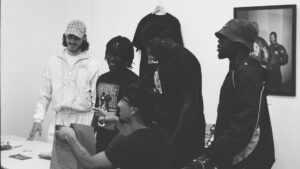
Through Our Eyes sits alongside that work as another piece of the same question: what does it mean to be African-Australian? Where We Outside focused on the present, this project expands the inquiry across generations. It looks not only at contemporary community life, but also touches on the past, how communities were established in Melbourne, the structures that supported them, and the relationships that have sustained them over time. Together, the two projects form part of an ongoing documentation of a young and growing community still shaping its identity within Australia.
The motivation for this work began during time spent overseas in the United States, where I encountered exhibitions dedicated entirely to photographers from the African and Black diaspora. Seeing these works was powerful, not because the cultural contexts were identical, but because they felt familiar. I could recognise my friends, my community, and myself within them. It was one of the first times I experienced representation in gallery spaces that did not feel marginal or explanatory. That experience prompted a question that followed me home: why had I not seen this kind of visibility in Australia, and how might we begin to create it?
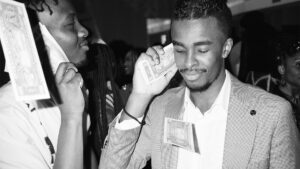
Rather than continuing to answer this question alone, Through Our Eyes was conceived as a collaborative project. I wanted other African-Australian photographers to share their own perspectives on community, love, and identity. The artists involved were not selected at random. Each has been part of my photography journey at different points, and our relationships have been built through shared interests in photography, art, and community- focused work. These connections shaped how the project unfolded.
The process required a high level of trust. The artists trusted me with their work and with a project led by someone still learning how to curate at this scale. That trust carried responsibility. It made us approach every decision carefully, particularly in image selection, sequencing, and presentation. While the artists worked independently, we intervened at the curatorial level by selecting and arranging the images together. Mentorship played an important role in guiding this process, and it became a space of learning together rather than authority.
The central questions posed to the artists were intentionally open. I did not want to dictate how they should respond. While the artists share an African diasporic identity, their experiences differ significantly. Age, upbringing, religion, ethnicity, and the timing of arrival in Australia all shape how community is experienced and understood. Allowing these differences to inform the work without constraint was essential to the project’s integrity.
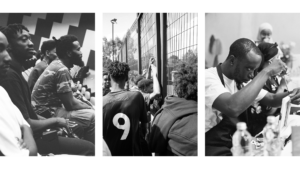
A key theme explored throughout our works is love. Love is often understood first as romantic, but that was not the intention here. Love can be expressed through family, friendship, care, faith, responsibility, and self-reflection. Within African-Australian communities, across different cultures and belief systems, love takes many forms. Photography is well suited to holding this complexity. A single image can contain multiple meanings, inviting viewers to reflect rather than arrive at a fixed conclusion. Several works in this exhibition challenged my own assumptions about how love might be represented, prompting deeper reflection on what was being shown and why.
Curating this work required me to refine how I evaluate photographs. Over the course of this project, I became increasingly conscious of the difference between an aesthetically strong image and one that carries narrative weight. A photograph can be technically accomplished, yet say very little. Learning to recognise that difference required slowing down, spending time with images, asking why certain works lingered, and reflecting on what they communicated. This process reshaped how I approached image selection and, more broadly, how I now think about photography, including my own practice.
What connects all of the works is a relational approach to image-making. These photographs are not voyeuristic. They are made from within community, by artists who share space, trust, and familiarity with their subjects. The people photographed are comfortable, open, and present. There is a clear difference between images made by someone embedded in a community and those made from the outside. This distinction matters. It speaks to authorship, consent, and care, and reinforces why it is important for African-Australian stories to be told by African-Australian artists.
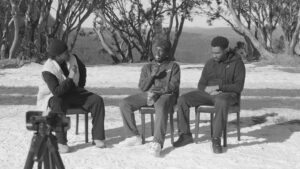
This exhibition is first and foremost for African-Australian and Black diasporic communities in Australia. It is a space to recognise familiar faces, places, and gestures, to see everyday life reflected back without explanation or justification. The artists collectively represent different parts of Melbourne (north, south, east, and west) as well as different generations, ethnic backgrounds, and relationships with Australia. In this way, Through Our Eyes becomes a broad, though not definitive, reflection of community life.
For audiences unfamiliar with African-Australian experiences, the work does not aim to educate through simplification or to be consumed as spectacle. Instead, it invites engagement through the same openness and attentiveness expected of any art practice.
There is an inherent responsibility in documenting one’s own community, particularly as part of a minority group. Individual actions and representations can be read as reflective of a broader collective. This makes accuracy, sensitivity, and care essential. Through Our Eyes does not claim to represent all African-Australian experiences, but it acknowledges the weight of representation and approaches it with intention.
I hope this work ages as a record of an early stage in the formation of African-Australian identity, one shaped by love, connection, and shared responsibility. I hope future audiences can look back at these images and understand where parts of that identity come from, and that people across the wider African diaspora might recognise parallels with their own communities.
Ultimately, Through Our Eyes is about perspective, who is behind the camera, whose stories are being told, and how those stories are shared. By placing African-Australian photographers at the centre of the narrative, the exhibition creates space for self-definition and reflection, and asks viewers to consider what it means to be African-Australian, and who gets to answer that question.
Curator Bio
Dr Ayooluwatomiwa “Ibukun” Oloruntoba is a Nigerian- Australian analogue photographer, curator, and project manager based in Melbourne. He values collaboration and prioritises sharing community voices through collective storytelling. His practice centres on creating and documenting spaces for African-Australian communities, often photographing from within these moments.
