
Curiosity
Turned Into
Responsibility
Movement
& Memory
BENNY KIMUTAI ROTICH
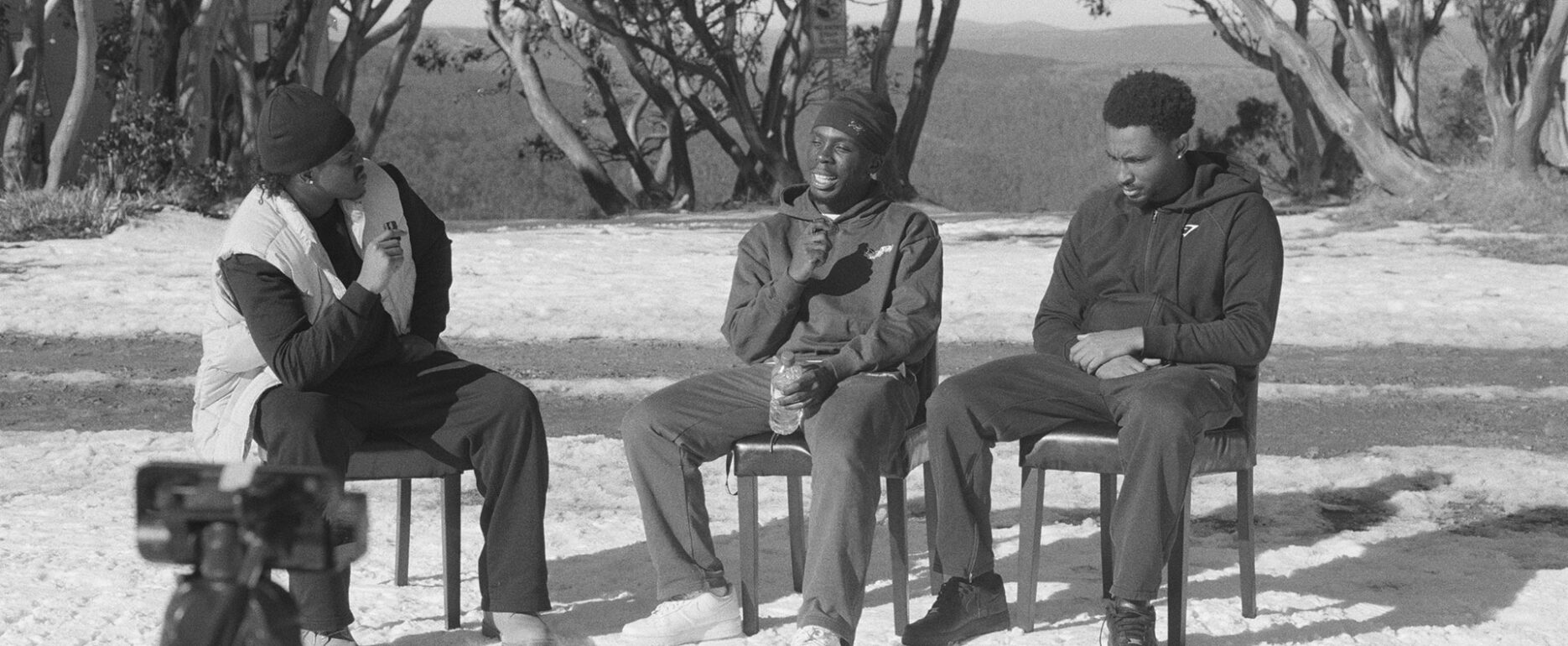
I did not begin documenting moments with the intention of making statements. I began because I was curious. Curious about how people gather, how culture survives distance, how joy insists on showing up even when it is not invited. Over time, curiosity turned into responsibility. Somewhere between filming friends dancing at community events, photographing quiet conversations at the edges of rooms, and watching artists shape worlds from memory, I realised that what I was capturing was not just content—it was evidence.
Through Our Eyes is a reflection of that realisation.
As a videographer and photographer working closely within African Australian communities, I am often positioned both inside and slightly outside the moment. I belong to the spaces I document, yet the act of holding a camera creates a pause, —a distance that allows me to observe more closely. This dual position has shaped my practice. It has taught me to look beyond spectacle and toward intimacy: The shared laughter between strangers, the nervous energy before a performance, the stillness that settles after celebration.
Much of my work exists at the intersection of movement and memory. African Australian stories are often framed through singular narratives—migration, hardship, resilience—flattened into digestible tropes. While these stories hold truth, they are incomplete. What is frequently missing are the everyday moments: the acts of love, creativity, rest, and joy that make life whole. My practice seeks to document those in-between spaces, where identity is not performed for explanation but lived without apology.
In collaborating with artists, musicians, runners, organisers, and everyday community members, I have learned that documentation is an act of trust. To be invited into someone’s process,—to witness vulnerability before polish,—is a privilege. Through these collaborations, my understanding of love has expanded. Love, I’ve come to see, is not always loud. Sometimes it is logistical. Sometimes it is showing up early, staying late, or holding space when things do not go to plan. These quiet forms of care are central to the stories I choose to tell.
The camera, for me, is not a tool of extraction but of participation. I do not aim to capture moments as an outsider looking in, but as someone moving alongside them. This approach has led me to prioritise presence over perfection. Grain, motion blur, imperfect framing—these are not flaws but reminders that the moment was alive. They signal that the image was not staged for consumption, but encountered in real time.
Nature has also become an important counterbalance in my work. Shooting outdoors—among trees, open skies, and uncontained spaces—has allowed me to place African Australian bodies within landscapes where we are not always expected to be seen. These settings challenge inherited ideas about belonging and access. They ask quiet questions: Who is allowed to rest here? Who feels safe enough to take up space? Who is imagined when we think of nature, leisure, and freedom?
Through Our Eyes is not a definitive statement. It is a collection of fragments—glimpses into moments that might otherwise go undocumented. Together, they form a visual language that resists singular interpretation. The exhibition invites viewers to slow down, to notice the subtle gestures that often pass unnoticed, and to reconsider what visibility can look like when it is shaped from within.
Ultimately, my practice is about care. Care for people, for process, for the stories that are still unfolding. I am interested in how documentation can honour complexity without simplifying it, how images can hold joy and tension at the same time. If this work does anything, I hope it affirms that our lives are not peripheral. They are layered, expansive, and worthy of being seen—on our own terms, through our own eyes.
Artist Bio
Benny Kimutai Rotich is a Kenyan born Melbourne-based filmmaker, videographer and photographer whose work sits at the intersection of community, culture and nature. Known for his minimal yet vibrant aesthetic, Benny creates emotionally grounded visuals that honour real people and real stories. His work spans events, documentaries and outdoor creative projects, weaving empathy, precision and storytelling into every frame.
