
Existing in
a Paradox
of Visibility
A Project
Still in the
Process
BASIL ABUBAKER
The Lives of African Australians is a documentary photography project within Through Our Eyes that follows moments from the lives of four African-Australian individuals. The work focuses on presenting each person in a photojournalistic style, situated within environments of personal significance. The project is informed by the work of Gordon Parks during his time at the Farm Security Administration (FSA) in the 1940s. The way his works captured the plight of African-Americans during that time, without being overly editorial or sensational was something that always appealed to me. His later works continue to be some of my favourite works by any photographer, but his tenure with the FSA and the way his camera provided a window into the lives of African-Americans in that time, is something that I hoped to emulate with my work in this project. That aspect of his work has a direct connection to how I have elected to shoot this project. More often than not the subjects have been captured with no direction or guidance from myself, I feel like this allows them to be themselves and allows me to observe and capture them authentically. The impact of Parks’ work, alongside my desire to contribute to the African-Australian archive in Melbourne, underpins this body of work.
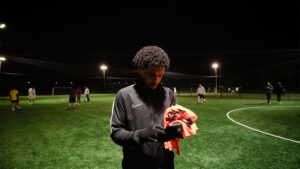
Much of the work required negotiation around time and access. Coordinating schedules and working within meaningful locations demanded patience, as each participant balanced professional and personal commitments. These constraints shaped the project, calling for an approach that respected participants’ routines while still allowing the work to unfold. Another challenge faced while shooting this project was the difficulty posed by accessing areas of importance for some of the subjects. One such example was a shoot that took place at Eyerus’ secondary school – a place of significant importance to her as an educator and youth advocate. However, due to the convoluted bureaucratic processes of image making at a school (even when the students are not the primary subjects and when you think that you have the correct approvals) – those photos are destined to never see the light of day. Other times access came naturally, as Mahmoud’s best man, I was lucky enough to have a front row seat at his engagement. Allowing me to capture a moment of immense significance for him and his family.

Early in the project, I began to notice a gap between the images I was drawn to as a photographer and the images that carried the weight of the story I was trying to convey. Images that looked the most polished or complete did not always carry what the story needed. This idea was reinforced throughout the image-making process and later through conversations with the curators. Recognising this required a more intentional approach to making photographs, one that centred the story and demanded ongoing awareness of when I began to drift away from it. This project has also taught me some valuable lessons about my process of image making. Perhaps in some way, I am a victim of my time and the technology that allows us to take hundreds of photos per shoot with little to no consequence – as I look back through my photographs I often find that I either got the image right the first time (captured the vision I had in my mind) or I have just continued to shoot aimlessly until I got tired of the composition and moved on to something else. Rarely has working the scene for longer than a few seconds to a minute yielded results I have been happy with. This project has also reinforced ( I already knew this) that I really do not enjoy posing people for photographs. I think it’s something that I have inherently known, the majority of my personal favourite photographs are not posed, but this project helped to internalise that idea.
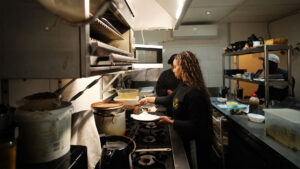
African-Australians are a small community that exists in a paradox of visibility, both underrepresented and overrepresented at the same time. This tension often stems from how rarely we are able to control our own representation or tell our stories on our own terms. I hope that these works will help inform and enlighten the wider Australian population to the interesting, complex, and multifaceted lives that people in our community lead. As well as the love that circulates between individuals and across the community as a whole.
This project remains ongoing.I intend to continue expanding it to include a broader range of voices, while carrying forward the insights gained here into future creative work. Alongside this, I am developing projects that further explore photography as a medium through experimentation, informed by my experiences within it.
Artist Bio
Born to Eritrean-Sudanese parents in Saudi Arabia and raised in the United Arab Emirates, Basil Abubaker’s practice is informed by a life shaped across multiple geographies. Frequent travels between the Middle East and Africa during his formative years embedded in him a profound awareness of place, identity, and belonging qualities that continue to underpin his relational approach to photography.
Since relocating to Melbourne in 2016, Basil has developed a practice that explores the human experience through intimate visual storytelling. His work traverses personal and collective narratives, reflecting on everyday life and its quiet intersections with culture, history, and migration. Working fluidly between film and digital formats, Basil selects each medium for its distinct capacity to evoke emotion, whether through the tactile nostalgia of film or the precision of the digital image. Across his practice, his images seek to capture the essence of lived experience, prompting reflection and inviting audiences to reconsider their relationship to the world and to one another.
