
Approaching
Space as a Lived
Environment
What
Remains
HUSSEIN ABDIRAHMAN MOHAMUD
What Remains approaches space as a lived environment rather than a fixed location. It is shaped by people, memory, and everyday use. The project explores community formation and transformation through the Somali experience in Melbourne, concentrating on sites where collective life has taken root since the 1990s.
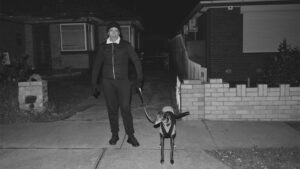
As a member of the Somali community and a photographer carrying a tool of capture that fixes ‘subjects’ in the scopic field, I enter these spaces while negotiating the challenges of insider and outsider status, situated between proximity and distance rather than firmly within each. Early on, I understood that working within these environments requires careful attention to cultural, religious, and personal sensibilities as they pertain to visibility and representation. Guided by how my presence provoked discussions which range from rejection to critiques of photography, I came to refine the scope, justification and the practice of the project. For instance, as a photographer who comes from a large Muslim family, I knew the process of what photographers call ‘capture’ is viewed precisely as capture. Of course, and I say “of course” intentionally, many people from the Global South know that photography has not historically been our friend.Early on I knew portrait did not necessarily mean the visibility, the staging of the face or other personal identifiers. Yet, these historical and contemporary concerns are not dogmatic prescriptions applied to every experience. In the case of Momma Khadija, a resident from the Flemington Flats facing eviction following the state government’s decision to demolish 44 housing estates across Melbourne, she asked me to set those considerations aside. She wanted to be fully visible, to show exactly how this decision has scattered 25 years of life as a resident of 120 Racecourse Road.
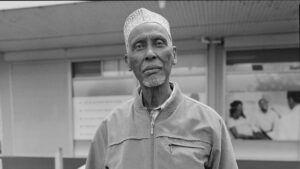
As a result, my photographic practice in this project is shaped by ongoing negotiation with the people I photograph. These conversations influence what can be shown and how images are made. Rather than treating this as a constraint, I see this process as integral to the work.
What Remains is an exploration of place not as a static backdrop but as a lived environment, continuously shaped by the movements, memories, and daily practices of the people who inhabit it. The project explores how Somali communities in Melbourne have formed, adapted, and transformed over time, paying particular attention to the sites where collective life and social connections have begun and taken shape since their arrival in the 1990s.
One of these places is Heidelberg Mall on Bell Street, an open-air shopping centre built in the 1950s. Following the collapse of the Somali government in 1991 and the ensuing civil war—a conflict shaped in part by the broader geopolitical impacts of the Cold War in the 1970s and 1980s—many Somalis arrived in Melbourne. Heidelberg West became a place of resettlement and continuity for many in this community. As the first families arrived, others followed, drawn to existing networks of support. Over time, the Mall developed into a thriving community hub: Somali-owned shops, community centres, money-transfer services, halal butchers, and other essential services transformed the site into a point of orientation and belonging. It functioned as more than a commercial space. It became a shared ground where everyday life unfolded and where diverse communities intersected, forming connections and affinities.
Currently Bell Street Mall is undergoing a significant transformation. Redevelopment of surrounding public housing is reshaping the built environment and demographics. These changes, driven by housing demand and broader gentrification pressures, are altering how residents interact and reducing foot traffic to the Mall.
Alongside this, What Remains looks to another, now contested, site: the public housing estates marked for demolition across Melbourne, in particular, the 120 Racecourse Road in Flemington. The Victorian State Government’s plan to demolish and redevelop these estates have placed thousands of residents in prolonged uncertainty, raising concerns about displacement, loss of community, and the erosion of public housing as a concept. I should note that, at the time of writing this, there is a pending class action concerning the demolition of the housing estates before the Supreme Court of Victoria.
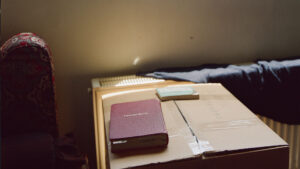
In these locations, the social landscape is drastically changing. Development in the surrounding area views these sites as things to be removed and reimagined, with redevelopment under the initiative “housing diversity” driving these transformations across Victoria and justifying rushed state demolition plans. These incursions displace communities, lives, and memories in the name of deliverable outcomes.
As these changes accelerate, I began more frequently visiting these locations. I photographed both the spaces and some of the residents, glimpsing into what is being erased and altered. Over time I came to understand how the project, guided by my interaction with the people of these communities, became less concerned with flux and change, and more about seeking to connect with what remains despite extraneous efforts to erase. Acknowledging that the potential demolition and drastic change of these spaces carry consequences for the people and communities far beyond relocation meant that I needed to reacquaint myself with beginnings in order to imagine a future that persists in loss. The preservation of social and familial proximity that organically developed is what is being lost and what is at stake. This relationship between people, community and places helped me to understand those who chose to resist, and even more so, the significance of what will remain.
What Remains is an on-going project.
Artist Bio
Hussein Abdirahman Mohamud is an emerging photographer based in Melbourne. Born in Somalia, Hussein and his family moved to Australia in the 1990s and lived in Heidelberg. He now resides in Coburg. Hussein’s lens is focused on places and people and the relationship between the two. His compositions emphasise spaces as components of community and people. Seeing photography as a communicative tool, he leans into the humanistic collaborative possibilities of the medium.
Hussein has exhibited locally in Melbourne and participated in group exhibitions. He recently produced a zine titled Street as part of CCP.PE.ZINE, a new collaborative publishing initiative by the Centre for Contemporary Photography (CCP) and Perimeter Books. Currently, he is working on two long-term projects: one in Somalia, documenting the lives of government workers. The other is in Melbourne, titled What Remains, which explores the Somali community in the city.
